

- Mariam Taofeek-Bakare | Premier World News
The United States has facilitated the signing of a new framework agreement between Israel and Lebanon, presenting it as an initial move toward peace after months of cross-border fighting involving Hezbollah.
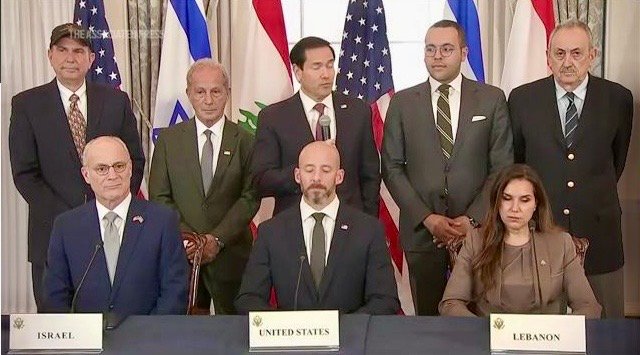
U.S. Secretary of State Marco Rubio presided over the signing ceremony in Washington.
The agreement was signed by Yechiel Leiter, Israel’s Ambassador to the U.S. and Nada Hamadeh Moawad, Lebanon’s Ambassador to the U.S.
According to the U.S. State Department, the framework creates a structured process to address two main objectives: the gradual dismantling of Hezbollah’s military capacity and the restoration of Lebanese state control over territory currently held by Israeli forces.
To implement the plan, declaration was made that Washington will establish and support a new “Military Coordination Group for Lebanon”.
The U.S. also announced the sum of $100 million in humanitarian assistance for Lebanon.
The State Department described the deal as offering Lebanon “a credible route out of a prolonged crisis”, while giving Israel “a verifiable mechanism to remove the ongoing threat along its northern frontier”.
Furthermore, one of the representatives, Ambassador Leiter said the ultimate aim is full peace between Israel and Lebanon.
He stated that progress depends on Hezbollah being disarmed and removed as a military force, which would then allow Israel to withdraw and enable Lebanon to “restore complete sovereignty”.
He buttressed that the success of the plan rests largely with the Lebanese Armed Forces, and expressed confidence in U.S. support for that effort.
Ambassador Moawad described the agreement as “the beginning of a journey” toward reinstating Lebanon’s sovereignty and territorial integrity.
She said it should secure a lasting halt to hostilities, allow displaced citizens to return and create conditions for peace and prosperity across Lebanon.
However, Hezbollah did not participate in the negotiations.
A senior member of its parliamentary bloc, Hassan Fadlallah made it known that the group rejects direct talks with Israel and will not relinquish its arms.
He warned that Lebanese authorities would be unable to implement the Washington agreement without U.S.-backed internal conflict.
He also claimed the deal was intended to disrupt ongoing U.S.-Iran discussions.
The current escalation began in late February, when Hezbollah launched rockets into Israel days after Israel and the U.S. initiated military action against Iran, while Israel subsequently entered southern Lebanon and expanded its presence.
Lebanese authorities report that more than 4,000 people have been killed in Israel strikes since March.
The says 37 of its soldiers have died in Lebanon or in northern Israel during the same period.
Lebanon’s negotiators have prioritized a full Israeli withdrawal from the south; Israel’s officials have made Hezbollah’s disarmament their primary condition.
In addition, Lebanese Prime Minister, Nawaf Salam said the agreement seeks an Israel pullout from all Lebanese territory, the return of displaced citizens and the extension of state authority through the national army.
Also, President Joseph Aoun disclosed that a proposal for “pilot zones”, where the Lebanese army would assume control as Israel troops withdraw, is under discussion and awaits Israeli approval.
Israel Prime Minister, Benjamin Netanyahu called the framework “a significant achievement”.
He stressed that Israel will keep a security zone in southern Lebanon until Hezbollah is disarmed and no longer poses a threat.
The Israel military, he said, is creating two pilot zones to begin a phased handover.
The Israel-Lebanon talks were conducted separately from a recent interim agreement between the U.S. and Iran, which established a 60-day period for negotiations on Tehran’s nuclear program.