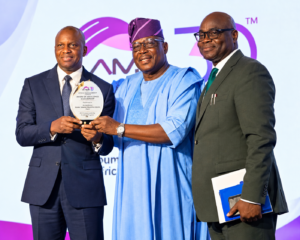


Convener of the For the Love of Country (FLOC) Symposium, Atinuke Odjenima, has called for a shift from certificate-driven education to practical competence, urging stronger collaboration between educational institutions and industries to improve employability, productivity and job creation in Nigeria.
Odjenima made the call at the fifth edition of the FLOC Symposium, tagged Symposium 5.0, held on Thursday, October 15, 2026, at the Presidential Conference Hall of the Olusegun Obasanjo Presidential Library, Abeokuta, Ogun State.
The event, themed “Building a Prosperous Future: Re-Engineering Education and Driving Industrialization for Innovation, Productivity and Jobs,” examined how education and industrial development could be better aligned to equip young people with skills relevant to the labour market.
Speaking on the purpose of the platform, Odjenima said FLOC was established to promote national development through constructive discourse and practical solutions to challenges confronting the country.
She explained that the symposium was not merely intended to discuss Nigeria’s problems but to encourage stakeholders to identify workable approaches to addressing them.
According to her, the 2026 edition focused on the relationship between education and industrialisation, particularly the skills employers require that graduates may not acquire sufficiently through conventional academic training.
Odjenima said the discussion centred on work readiness, youth employability and skills development, with the broader objective of strengthening the connection between what students learn and the demands of the workplace.
She argued that educational achievement should not be measured solely by possession of qualifications such as bachelor’s degrees, Higher National Diplomas or postgraduate certificates, but also by the practical abilities individuals develop and can apply to real-world challenges.
“If I met the President today, I would say education should shift from certification to capability,” she said, stressing the need to place greater emphasis on what learners can do with the knowledge they acquire.
However, Odjenima noted that practical competence must be built on a sound foundation of knowledge, adding that industrialisation cannot be sustained without education, research and innovation.
She called for stronger collaboration between industries and educational institutions, urging employers to help schools identify skills gaps and incorporate industry challenges into academic curricula.
According to her, closer cooperation would enable institutions to develop programmes that respond more directly to changing workplace requirements, while helping young people become better prepared for employment and productive enterprise.
She also emphasised that education should not be limited to conventional classroom learning or formal academic qualifications, but should encompass vocational training and skills acquisition for people working in different sectors of the economy.
Odjenima said the productive capacity of a country depended significantly on how well its citizens were equipped to contribute to economic growth, support their families and improve their livelihoods.
The symposium’s focus reflects FLOC’s stated objective of connecting education, skills development, industrialisation, innovation and employment.
The organisers have also outlined a proposed post-symposium initiative, the FLOC–Ogun Education–Industry Capability Accelerator (FEICA), intended to support collaboration between educational institutions and industry through skills-demand mapping, curriculum alignment and structured pathways from training to work.
The initiative is designed to move discussions beyond the event towards practical implementation, although its proposed activities should be distinguished from any policy or programme formally adopted by government.
FLOC Symposium 5.0 continued the platform’s series of national development conversations, with earlier editions addressing human capital, national integration and economic development.
The 2026 edition placed particular emphasis on the role of relevant skills and productive industries in creating employment opportunities and supporting a more competitive economy.
Odjenima maintained that education and industrial development should be treated as complementary parts of national progress, with schools, training providers and employers working together to prepare people for the opportunities and demands of a changing economy.